
Third Doctoral Colloquium: Shaping the future of Visual Heritage at the gateway to Europe
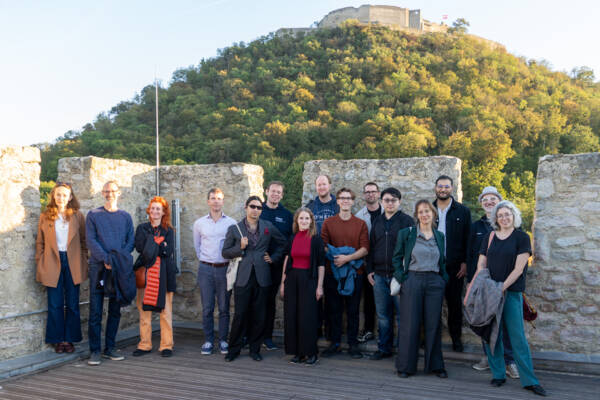
Participants of the third Visual Heritage Doctoral Colloquium on Hainburg’s medieval city walls, with the castle ruins on the Schlossberg in the background. Left to right: Susana Zapke, Matthias Zeppelzauer, Silvia Miksch, Michael Loebenstein, Armin Dadras, Andreas Maier, Michaela Tuscher, Florian Kleber, Florian Kibler, Markus Passecker, Tingyu Lin, Anna Högner, Nidham Tekaya, Wolfgang Aigner, Franziska Proksa.
The third Visual Heritage Doctoral Colloquium took place on October 6–7, 2026, in Hainburg an der Donau, a medieval town in Lower Austria located between the Danube floodplains and the Hainburg hills, close to the Slovak border and the Roman site of Carnuntum. The Hotel Altes Kloster served as the venue for two days that brought together PhD students, core faculty, associated faculty, members of the advisory board, and external experts to discuss and advance research at the intersection of visual computing and cultural heritage.
The choice of location was no coincidence. Hainburg is the site of the future European Campus Hainburg, a joint project in which USTP – University of Applied Sciences St. Pölten and TU Wien, the two partner institutions of the Visual Heritage PhD program, will bring a university of applied sciences and a technical university together on a shared campus for the first time in Austria. The campus will be built at the foot of the Schlossberg and is scheduled to open in 2028. Holding the colloquium here offered a fitting backdrop for a meeting that looked not only at the current state of the PhD projects but also at the future of the program.
As the program enters its final phase, the colloquium set five goals: to deepen the understanding of the current PhD research projects and their interconnections, to receive constructive feedback from the advisory board and domain experts, to gain new perspectives through invited talks and discussions, to develop concrete concepts and priorities for a follow-up PhD program proposal, and to strengthen professional networks while exploring academic and non-academic career paths.
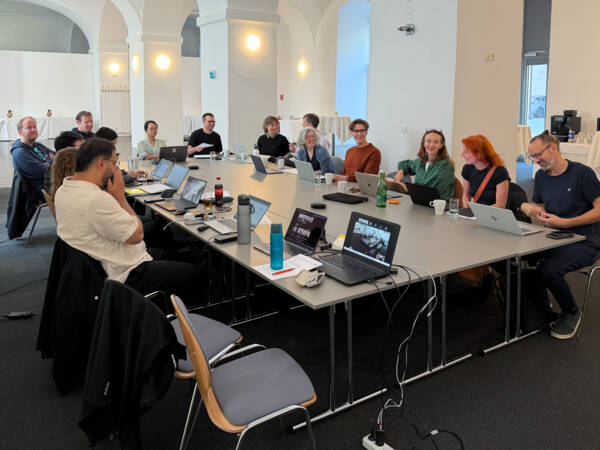
Intensive discussions in plenum at the Hotel Altes Kloster.
Day 1: Status updates and the next generation of research topics
Wolfgang Aigner, coordinator of the PhD program, opened the colloquium with a welcome and an introduction of the agenda, followed by a short introduction round led by Matthias Zeppelzauer. As in previous colloquia, each PhD work session followed a structured format: a short presentation covering current status and demos or prototypes, followed by a 45 minute work session in plenum. With the end of the program in sight, the sessions this year also included a reflection on how to wrap up the individual theses.
Nidham Tekaya started the series of work sessions with his research on context analysis in historical imagery. Building on his work on how vision-language models represent time, he presented a benchmark for investigating how the meanings and contexts associated with visual subjects change across historical periods. The work combines source-grounded descriptions, domain-expert review, and controlled image generation to assess how computational models identify context and trace change over time. He also outlined plans for interactive exploration tools that would allow users to investigate these changes and refine retrieval through feedback.
After the coffee break, Miriah Meyer from Linköping University joined remotely for her invited talk “Vis in Public Places”, which explored visualization outside the lab and in public settings, an inspiring perspective for a program concerned with making cultural heritage accessible. Michaela Tuscher then presented her research on relationship analysis in cultural heritage, focusing on how visual analytics can reveal connections between artists through their exhibition histories. Her work explores how artists' positions in co-exhibition networks change over time and how interactive visualizations can help researchers compare artists and investigate similarities within and between groups. She also presented ongoing work on combining hierarchical grouping with network views to explore these relationships from different perspectives.
The afternoon opened with an invited talk on “Visitor Experience in Cultural Heritage Sites supported by Technology” by Paolo Buono from the University of Bari Aldo Moro, followed by Markus Passecker’s work session on situated storytelling. Passecker presented mobile AR approaches that bring historical photographs back to the places they depict, keeping the archival documents recognizable rather than reconstructing an imagined past. Drawing on a field study in Vienna's Prater, he discussed how different interfaces support exploration and comparison across time, and how to balance engagement with historical images on screen with attention to the surrounding site. An outdoor hands-on demo session sparked lively discussions on situated visualizations in heritage sites.
Building on the experience gained in the current program, participants collected challenging open research questions and possible directions for future work.
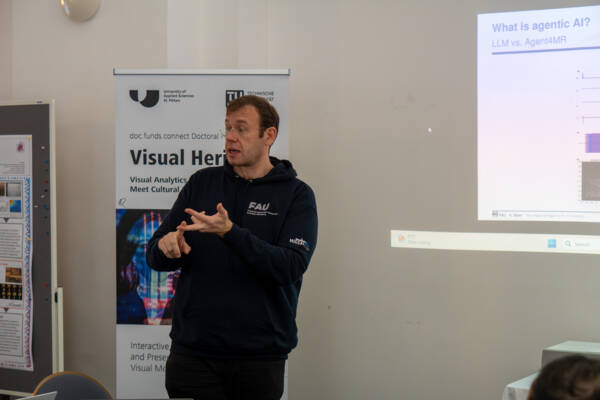
Andreas Maier (FAU Erlangen-Nürnberg) on “The Impact of Agentic AI on Science”.
Day 2: Agentic AI, careers, and interpretation
The second day began with an invited talk by advisory board member Andreas Maier from FAU Erlangen-Nürnberg on “The Impact of Agentic AI on Science”. His talk raised timely questions about how AI agents are changing the way research is conducted. Following that, Franziska Proksa held a work session on career opportunities where PhD students and senior researchers discussed career paths after the PhD, both in academia and beyond, as well as funding opportunities for the next steps.
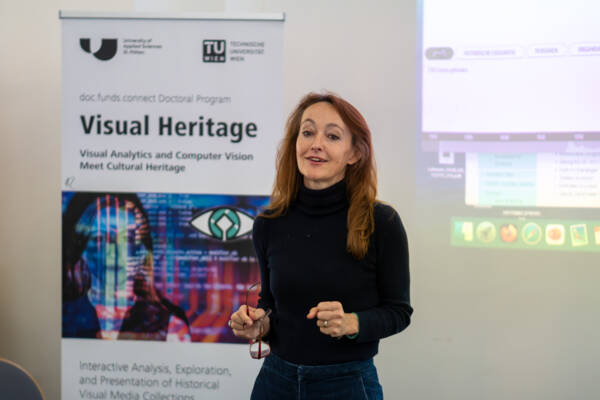
Susana Zapke on “Visualization, Objectification, and the Ambivalence of Interpretation”.
Associated faculty member Susana Zapke from the Music and Arts University of the City of Vienna (MUK) followed with her invited talk “Visualization, Objectification, and the Ambivalence of Interpretation”. Using examples such as interactive music mapping of Vienna, she reflected on how visualizations shape and objectify interpretations of cultural data, an important critical perspective for the computational approaches developed in the program. Armin Dadras then presented the latest progress of his research on composition detection.
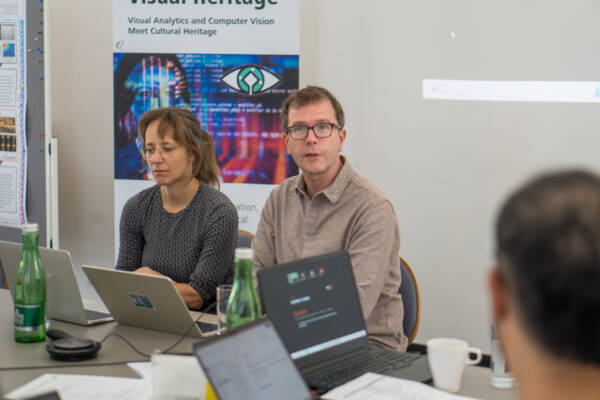
Michael Loebenstein and Anna Högner (Austrian Film Museum) on “State of the art. State of the art?”.
After lunch, Michael Loebenstein and Anna Högner from the Austrian Film Museum gave their invited talk “State of the art. State of the art?”, which questioned what “state of the art” means from the perspective of an archive and its collections. The final work session belonged to Tingyu Lin, whose research investigates how computational methods and expert knowledge can support the interpretation of creator intent in historical photographs and films. He presented advances in detecting shot boundaries and classifying camera movements, alongside ongoing work on framing analysis. Looking beyond automated detection, he outlined a knowledge-assisted visual analytics approach in which observations remain linked to the original footage and experts can inspect, contextualize, and enrich them. His presentation raised questions about when machine-generated observations can count as evidence, how material from different archives can be compared, and what would make such tools useful in research practice.
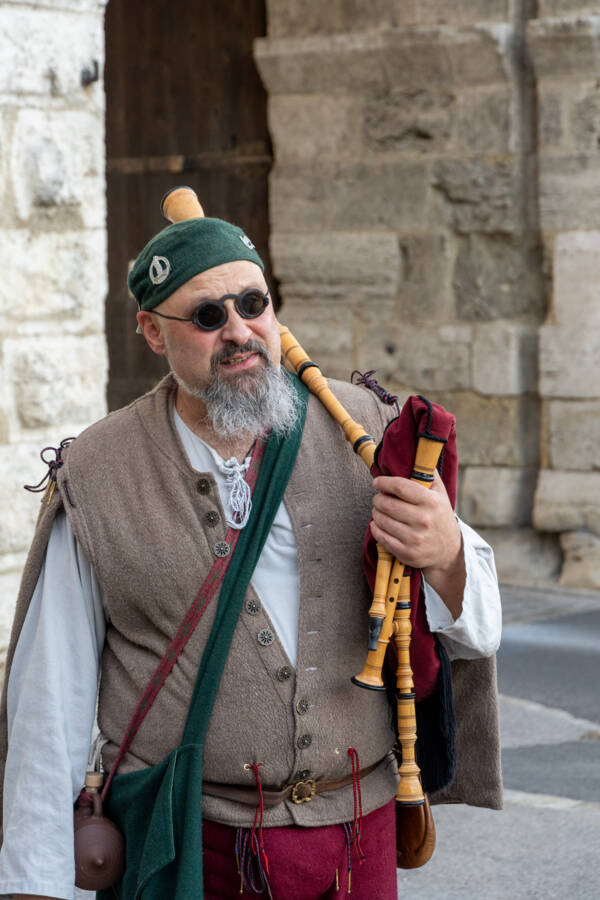
A guide in historical costume leads the group through medieval Hainburg.
Cultural and Team-Building Activities
True to the program’s tradition of experiencing cultural heritage first-hand, the first day ended with a guided city walk through Hainburg. Led by a guide in historical costume, who accompanied his stories with the sounds of the bagpipes, participants explored one of the best-preserved medieval fortifications in Europe: about 2.5 kilometers of city walls, 15 towers, and three historic city gates dating back to the 13th century, including the Wienertor, the largest medieval city gate in Europe. From the top of the walls, the group enjoyed views across the old town, the Schlossberg with its castle ruins, and the Braunsberg, before the day came to an end with a sunset on the banks of the Danube.
Looking Ahead
The colloquium concluded with a wrap-up session led by Silvia Miksch, in which participants shared feedback and discussed future planning. The third colloquium showed how far the individual PhD projects have matured and how they are increasingly converging towards their completion. At the same time, the discussions in Hainburg marked an important starting point for the next chapter: the ideas collected for a follow-up PhD program will be developed further in the coming months, with the aim of continuing and expanding the collaboration between visual computing and cultural heritage research. Hainburg, soon to be home to the European Campus, proved to be a fitting place to look into the future.


